The First Christian Church Disciples of Christ is located on East Church Street near the Berryville Town Square. Worship Services are at 11:00 AM on Sunday. Bible Study at 1:15 PM Tuesdays.
Tuesday, May 31, 2011
Putting on Some Peace Paint
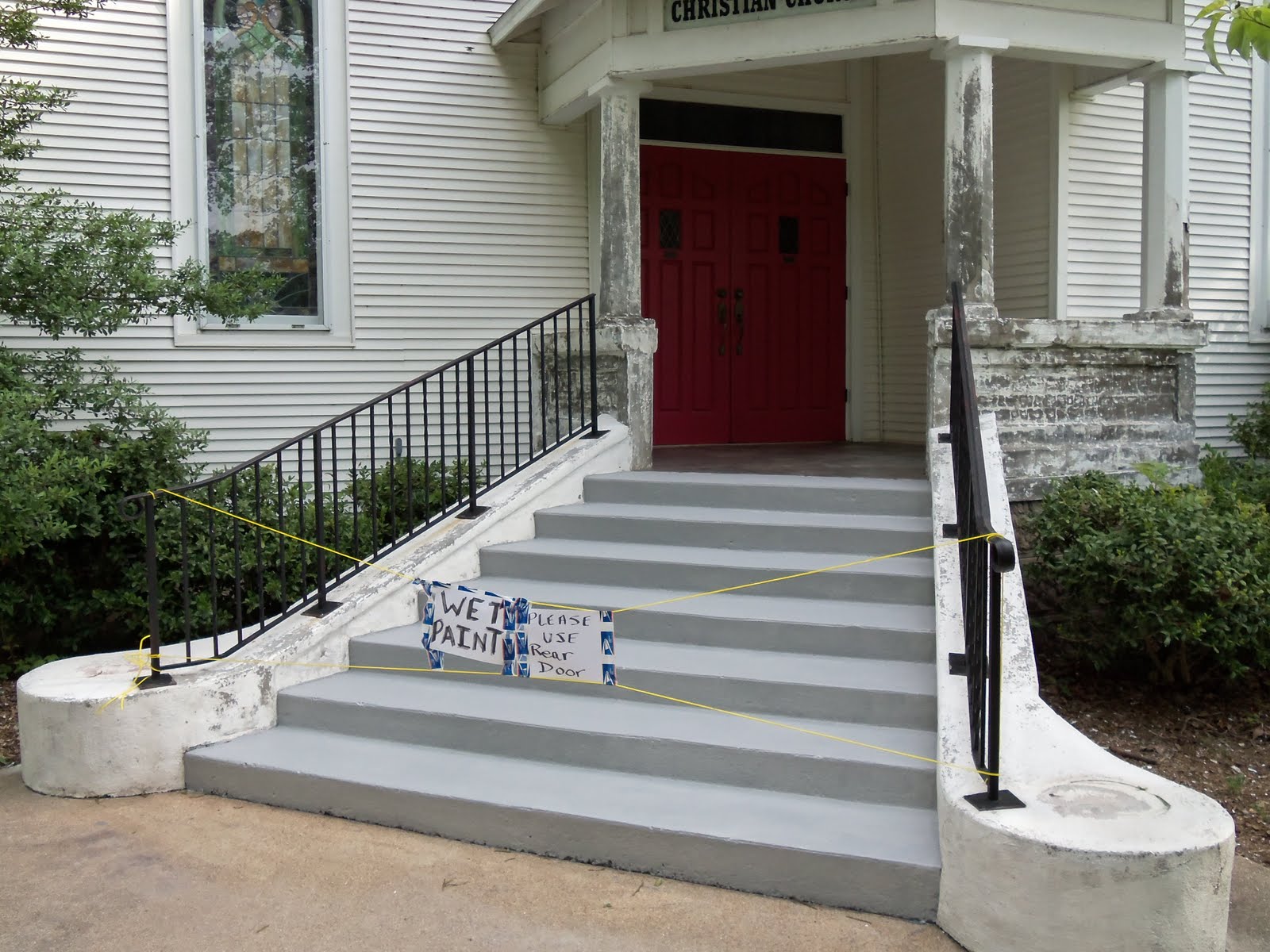
Older members of the congregation might remember using the phrase "she's putting on her war paint" to describe their wife's make-up preparation for a social outing. This week we've been putting on some "peace paint" and otherwise cleaning up the entrance to the church.
Please excuse the mess--which is short lived--and use the back entrance to the church until further notice.
Sunday, May 22, 2011
Mr. Magoo was in the Little Sprouts garden this morning building something when he happened upon a whole gaggle of disgusting creatures eating a plant. They were really eating it: nothing was left but the stalk.
Mr. Magoo, who as you know is deaf, blind but sadly not dumb--dumb is an old word for describing someone who can't talk--killed six of the wormy yucks by squeezing their tiny little heads between the grippers on a pair of pliers. He was so happy!
"Oh, no!" shouted two Little Sprouts. "Those are baby Monarch Butterflies!"
Mr. Magoo, who is deaf and blind but can still talk, denied that the ugly worms were baby butterflies. But they were! Isn't it terrible that Mr. Magoo can talk?
The moral of the story is: Mr. Magoo should only build things! He does not know ANYTHING about butterflies! Don't listen to him!
Wednesday, May 18, 2011
Wedding Open House 9-12 PM Saturday

The First Christian Church Berryville--on Church Ave across from Nelson's Funeral Home--is having an Open House this Saturday from 9:00 AM to 12 PM for prospective brides and families planning a wedding this summer or fall. Stop by the Open House and talk with our wedding planners about holding your wedding at our historic and elegant small church.
Thursday, May 12, 2011
Community Garden Update
One hundred percent (100%) of the Community Garden is now planted and, despite the rain, we're hopeful that everything will go forward and do what they are supposed to do: be fruitful and multiply.
Our potatoes and onions are in good shape and the blueberry bushes, after a very rocky 2010 when they were planted, have perked up a bit and may survive this year: we are not yet convinced that they will thrive, sad to say. Our tomatoes are in the ground--a bit wet but green and inching upward, and cucumbers, bush beans, and snow peas are behaving as expected. All the lettuce, spinach, and salad greens--which we had in such abundance last year--washed out this spring and so, and alas, no salad until we plant again in the fall.
One of the beds on the east side of the garden gets too much shade to grow much so we're experimenting with blackberries. So far, 9 of ten canes have popped out of the ground and are looking okay (just). We hope planting these space intensive fruits pays off because we LOVE blackberries.
Squash was planted just north and adjacent to the Little Sprout's Garden. They got beat up during planting (Mr. Magoo dragged a hose over them), but four of the eight hills look like they'll make it--and we'll replant the others pretty quick.
If you have time, stop by the garden. It will put you in mind of God's goodness to us. And: THANK YOU for making the garden possible.
Thursday, April 28, 2011
Administrative Update

Update from the Office
An electronic master calendar has been created which facilitates the establishment of a yearlong schedule of key meetings: the Elders, the Board and the Ministry Council, plus all other activities which utilize our facilities. Electronic reminders will be sent and this information has been transferred to a large, wall mounted calendar in the office for easy viewing by any member seeking to schedule church facilities for an event. This will also facilitate the timely posting of announcements in the weekly bulletin.
How you can help?
1. If you wish to schedule an event, contact Susan Krotz, to ensure the date(s) you request are available
2. If you hold a leadership position in the church, please check that mail slot in the office. The mail, which may include bank statements or bills, is piling up and needs your attention. These positions include, pastor, Chair, Co-Chair, Treasurer, Women's Group, Youth Director, Choir Director, Finance Committee, Memorial Fund, among others
3. Get ready to act: We have received requests to update our current Membership Directory and will be seeking information about any changes in your household. Stay tuned for how you can quickly ensure your contact information is up to date.
4. As a cost saving measure, because we so rarely have needed to make full color copies, that function on the copy machine has been password protected. If you need to make color copies for church events or programming, please contact David Bell or Susan Krotz .
5. Volunteer Opportunity: Office Staff. Duties include: phone answering, filing, supply management, some copying. Training provided. Benefits: Stewardship – giving of one’s time and talent for the strength of our church. Contact Susan Krotz for more information.
Tuesday, April 26, 2011
That I Might Know Him and the Power of His Resurrection
Sermon for Morning Worship, First Christian Church, Berryville
April 24, 2011
Job 19:23-27; Luke 24:1-12; Philippians 3:7-14
In writing to the Philippians, Paul said, 7 But whatever gain I had, I counted as loss for the sake of Christ. 8 Indeed, I count everything as loss because of the surpassing worth of knowing Christ Jesus my Lord. For his sake I have suffered the loss of all things and count them as rubbish, in order that I may gain Christ 9 and be found in him, not having a righteousness of my own that comes from the law, but that which comes through faith in Christ, the righteousness from God that depends on faith— 10 that I may know him and the power of his resurrection, and may share his sufferings, becoming like him in his death, 11 that by any means possible I may attain the resurrection from the dead. 12 Not that I have already obtained this or am already perfect, but I press on to make it my own, because Christ Jesus has made me his own. 13 Brothers, I do not consider that I have made it my own. But one thing I do: forgetting what lies behind and straining forward to what lies ahead, 14 I press on toward the goal for the prize of the upward call of God in Christ Jesus.
Just a little enrichment of that text: back in verse 10, "may share his sufferings" could also be translated, "may know the sharing in his sufferings," "may know the participation in his sufferings," "may know the fellowship of his sufferings," or "may know the community of his sufferings." The key Greek root word is koinonia, and as Paul uses it, it has to do with what we do in solidarity with our fellow believers.
I have preached on this text several times in the past three years, sometimes emphasizing the surpassing worth of knowing Jesus, sometimes emphasizing the righteousness that comes by faith. Today, I have a different emphasis. Why have I chosen this text again on Easter Sunday? Because it is one thing to believe that Jesus rose from the dead, and it is another thing to experience the power of his resurrection. Paul wants to experience the power of Christ's resurrection. He wants his first readers to experience the power of Christ's resurrection. He wants us to experience the power of Christ's resurrection. Easter people should experience the power of Christ's resurrection. So today we are exploring what the power of Christ's resurrection is and how we might experience it.
Paul wants us to know in personal experience the power of Jesus’ resurrection. I wish to suggest that knowing in our personal experience the power of Jesus’ resurrection is a good goal for us to set for ourselves on Resurrection Sunday 2011.
Paul, having been called by Christ to be his own, is pressing on toward the fulfillment of this calling. He sees it as a two-step process, a dying and a rising.
In writing to the Romans, Paul had said that, when we are baptized, we are baptized into Christ’s death and resurrection, dying with Christ to sin and coming alive with Christ to the living God. Now writing to the Philippians, he is talking about how he views the dying and rising in his own life.
Paul has accepted that his journey as a Christ-follower may not have an easy road in this world. Of the New Testament figures you would consider the greatest apostles, which of them would you say had an easy road of it? Peter? Andrew? James the fisherman? John? James the brother of Jesus? Paul? No, not one! In fact, Paul’s goal is to be so like Jesus as to “share in his sufferings, becoming like him in his death.” This does not mean that Paul was seeking to become a martyr, but that he was seeking to devote himself so fully to Christ that he would not turn back no matter the cost. As he said earlier in his letter to the Philippians, he took the attitude that to live is Christ and to die is gain, and that he was ready to be faithful either way. At that time, he expected that he would live a little longer for the sake of the churches he was leading. A few years later, writing his Second Letter to Timothy, he expected correctly that his time on earth was drawing to a close, but he still sought to live every bit of it for Christ. His goal at the end, was to be able to say, “I have fought the good fight, I have finished the race, I have kept the faith.” He did not expect to stop living until he died, and, because of the power of the resurrection, he did not expect to stop living even then. It is only people who are prepared to experience the cross who experience the power of the resurrection.
Paul is not a masochist who enjoys suffering. He does not glorify suffering for its own sake. He is not seeking to suffer. Suffering is significant only as it comes in the course of sharing and living out Christ’s self-giving love, only as it involves dying to ourselves so that we might live for God. Wherever there is godly dying, we ought to expect to see the glory of the resurrection in some way coming on its heels.
Already in this life, by prioritizing faithfulness to Christ at all costs, Paul has died to his own achievements, and he has come alive to the spiritual journey into Christlikeness. Once Paul meets Christ, the question is no longer what Paul can make of himself, but what Paul will allow Christ through the Holy Spirit to make of him. Paul wants to be conformed to Christ in his dying and in his rising. For Paul, glory is no longer defined by what he has accomplished, but by the transformation he is experiencing through his faith in Jesus. He is moving on from one degree of glory to another as the risen Christ through the Holy Spirit works within him. This is the power of the resurrection at work in Paul. Paul wants the same for us. He wants us to know in personal experience the power of the resurrection.
What does it mean to know the power of Jesus’ resurrection? What is that power? Paul’s word for power is the Greek word dunamis from which comes the English word dynamite. Okay, dunamis does not mean dynamite. Dynamite had not been invented yet. Our subject is the power of the resurrection, the power of salvation, the power of miracles, the power that makes all things possible; the power that means that nothing that accords with the will and character of God will be impossible. The reason that most churches in our day do not have much impact is that they are simply not aware that they have power, dunamis. Too many of us Christians have been sleeping on spiritual dynamite without even knowing we have it. Say it with me: Dynamite! I am not sure that saying dynamite is very enlightening, but it is fun to say, and it keeps us on our toes, so we will keep saying it.
The power of Jesus’ resurrection is tied to the power that the risen and exalted Jesus exercises from his position of authority at the right hand of God. In his Letter to the Ephesians, written sometime near the time he wrote to the Philippians, Paul prayed that his readers might have the eyes of their hearts enlightened to know, among other things: … what is the immeasurable greatness of his power toward us who believe, according to the working of his great might that he worked in Christ when he raised him from the dead and seated him at his right hand in the heavenly places, far above all rule and authority and power and dominion, and above every name that is named, not only in this age but also in the one to come. And he put all things under his feet and gave him as head over all things to the church, which is his body, the fullness of him who fills all in all.
That’s quite a mouthful, and it is only part of Paul’s long sentence. Let’s break it down: The power that is available in our experience is the same power that raised Jesus from the dead, the same power that exalted Jesus above all spiritual powers, and that means above all the forces of evil at work in our world. The power that raised Jesus from the dead put all things under his feet including the last enemy death. The same power made Jesus head over the ongoing mission and fellowship of the people of God, the church. Putting that another way, the power of the resurrection has given believers in Christ a friend in the very highest of places, and he will share his power and authority with his earthly body, the church. If we will let him, he will break the power of evil over us and free us to be filled with his power for good. Say it with me: Dynamite!
That’s extraordinary! To the degree that we are in Christ, we wield a mighty power for good in this world. A little later in his letter, Paul assures us that God is able to do far more abundantly than all that we have yet dared ask or think or imagine, through the same power that is already at work within us, the power of the resurrection. Wow! Far more abundantly than we have dared dream! Say it with me: Dynamite!
How does the Lord fill us with this power? A few years earlier in his ministry, Paul had written to the Romans, “If the Spirit of him who raised Jesus from the dead dwells in you, he who raised Christ Jesus from the dead will also give life to your mortal bodies through his Spirit who dwells in you.” God the Father, who by God the Holy Spirit raised God the Son from the dead, by that same Holy Spirit gives us our new birth as children of God. Paul continues, “The Spirit himself bears witness with our spirit that we are children of God, and if children, then heirs—heirs of God and fellow heirs with Christ, provided we suffer with him in order that we may also be glorified with him.” The power of the resurrection is the power of the Holy Spirit, which in turn is the power that transforms us into children of God in God’s image. Say it with me: Dynamite!
In the end of all history, God will bring about a new heaven and new earth, a perfected new creation where God—Father, Son, and Holy Spirit-- will reign fully and perfectly and where believers will reign with him. But already, now, God’s reign is breaking into this world with signs and wonders, transformations, and new possibilities of godly living. Over time, even through intense difficulties, faithful people learn to see that God reigns even now. Nothing that happens can separate us from his love and promises. No illness, no natural disaster, no world war, no financial collapse, no spiritually and morally wayward cultural climate, no family breakdown, no illness or affliction can separate those who persevere in faith from God’s perfect plans for us. Even in human upheaval, God reigns through and for his faithful children. Say it with me: Dynamite!
And since God reigns, death does not have the final word, nor does evil. The power of death and evil was broken when Jesus died on the cross and was raised from the tomb. However history appears, its true meaning since that first Resurrection Sunday, has been the conducting of a mopping up operation. The outcome is already decided. Only the details are still being worked out.
Long after World War 2 was over, an occasional story would appear about a Japanese soldier being found in an island jungle who did not yet know that the war was over. The majority of our world’s population is still in that unenviable position of not knowing that Jesus has already won the war by means of the power of the resurrection. They do not know it because the church has been sleeping on its dynamite, the power of the resurrection. It is high time for us to know the power of the resurrection, to know it in real life experience, and to get it out in the open where it can do some good. Let us study and pray and take actions toward that end. Say it with me: Dynamite!
The Meaning of All History Rests on This
Sermon for the Berryville Alliance of Churches Sunrise Service
8:00 A.M., April 24, 2011
Isaiah 52:7-10; Psalm 118:1, 10-29;
John 20:1-18; 1 Corinthians 15:1-19
I am going to tell you about Abram Jones. If you happen to know an Abram Jones, this is not the same one. The reason I know that he is not the same one is that this Abram exists only in my own mind. Abram had gone to Sunday school as a child, but along the way through adolescence and young adulthood he had gradually assembled a case from the History Channel, the Discovery Channel, the leading news magazines, some Internet surfing, plus a New Testament survey course in college that was taught by an atheist, that the death and resurrection of Jesus was simply a variant on common ancient myth about spring rebirth with no connection to historical reality. Based on this rather flimsy and easily discredited theory, Abram announced that he was no longer a Christian, but an existentialist. Now for some people the existentialist philosophy has specific content, but for Abram, it was just his way of saying that he would make up whatever meanings he wanted for his life as he went along, and it would save him a lot of time and trouble and money on church activities, and a lot of fretting about whether he was sinning or not.
But here are some well-supported historical facts that Abram did not consider:
1. Jesus was unmistakably dead when he was taken down from the cross on Friday afternoon. Abram could have read a pretty convincing case for that, in full medical detail, in an old Journal of the American Medical Association article posted all over the Internet. Jesus really died on the cross.
2. According to the Scriptures, when the reign of God broke through early on Sunday morning, with a great earthquake and shining angels, an angel of the Lord rolled back the stone that had been sealed over the entrance to the tomb and then sat upon the stone. The guards who had been assigned to guard the tomb trembled and became as dead men, presumably passing out from fear. The women, a considerable collection of them who had followed Jesus from Galilee and of whom only a few are named, came to the tomb to complete the anointing of the body of Jesus, an anointing that had been begun by Joseph of Arimathea and Nicodemus before the arrival of the Sabbath at sundown Friday. The women as they arrived at the tomb found an extraordinary scene and a message from the leading angel which first terrified them into silence, but then, apparently gathering their courage, they carried the message to the inner core of eleven disciples who did not believe them. Peter and John ran to the tomb and found it as the women had said. This caused them to believe something, although we are not told what they believed at that point, perhaps only that the tomb was empty. But that is a significant piece of evidence in itself. The account does not appear to be contrived because a contrived story in that culture would not have started with women witnesses and scared and skeptical disciples.
3. The Scriptures give more attention to the appearances of the risen Jesus: first to Mary Magdalene, then to Cleopas and another unnamed follower, then to the eleven, repeated times, both in Jerusalem and back in Galilee, then to more than 500 at one time, most of whom were still alive 20—25 years later when Paul wrote 1 Corinthians, then to Jesus’ brother James and presumably to his other brothers who had not been believers during Jesus’ earthly ministry, and finally in a different manner, years after his ascension, to Paul on the Damascus Road. The resurrection appearances taken together affirm that Jesus’ resurrection body is at once physical and yet not limited by the laws of physics. It is a new kind of body. He can walk, talk, eat, even cook breakfast, allow himself to be touched in his wounds from the cross, but he can also walk through walls and appear and disappear at will. This is a new kind of existence.
4. If that is not yet enough evidence, then consider this: these formerly fearful disciples who ran away when Jesus was arrested, who were still hiding behind locked doors at the time of his first resurrection appearances, began, within 50 days of the resurrection, to publicly proclaim that Jesus who had been crucified, was now the risen and exalted Christ, the Son of God, the Savior and Lord for all the world. These disciples, empowered by the Holy Spirit, who came to those who believed, carried the gospel to the entire Mediterranean world and beyond, many becoming martyrs of the faith in the process. Tradition says that all the original eleven were martyred, with John being the last to die in exile on Patmos, perhaps the only one to die in old age. The message of the risen Jesus was not for them the path to political power or worldly wealth. There was no earthly reason for them to risk their lives repeatedly over the years unless they were utterly convinced that Jesus was risen from the dead.
It has been claimed with some justification that we have better evidence for the crucifixion and resurrection of Jesus Christ than for any other ancient event. That is as it must be, for no other event in history so challenges ordinary human reasoning. What would be different for Abram Jones if he knew evidence for the resurrection?
If Abram was convinced by the evidence that Jesus was indeed crucified to death and then raised from the dead in a new kind of physical body, then the following things are also true:
1. God is absolute sovereign of the universe, reigning even over death. Abram would acknowledge God’s rule over his life.
2. God has placed the divine stamp of certification on Jesus as the one-of-a-kind Son of God, Messiah, Lord, and Savior. Abram would deal with the utter uniqueness of Jesus Christ by becoming his disciple.
3. God has planned a future new heaven and new earth where those whom Jesus recognizes as living in him will share resurrection bodies like his and share his reign over a perfected creation in which death and grief and strife will be no more. Abram would know that death is not the last word on our lives, that there is solid reason to hope for more and better.
4. Our goal for life beyond death is not to slip away from the material realm into an ethereal realm where we float on the clouds and play harps, but to be transformed for a realm that is at once material and spiritual, that is as material and spiritual as God planned life to be before there were sin and death, purified and durable material existence infused with the life of God. Abram would have a solid goal for his life both now and beyond death.
5. The meaning of our present lives is to live even now as reborn children of God in God’s inbreaking kingdom. Our lives are given over to proclaiming, demonstrating, and celebrating the reign of God as we represent his mercy, grace, compassion, longsuffering, and his abundant steadfast love and faithfulness, cooperating with the Holy Spirit as the Spirit produces in ever greater degrees the fruitof Christ-like living in us. In this way, our character and preferences are being pre-shaped for the future new heaven and new earth, and they are helping others believe our message about our good and sovereign Creator, our loving Lord and Savior. Abram would have guidelines that would help him live now in a way that is fitting to the future that has been promised.
In short, Abram would have resources of hope, faith, love, purpose, courage, and deep joy that he has not even imagined as possible.
Although Abram Jones had never given the matter much thought, he bears the name of a major Bible character. The biblical Abram was, late in life, called by God to a journey of faith. As he neared the fulfillment of his journey and was about to pass the milestone that would bring all the promises of God for him into place, God changed his name to Abraham, meaning “father of multitudes,” starting from one embryonic Isaac. Eventually from one man, and him as good as dead, came not only all the physical offspring of Isaac and his son Jacob/Israel, but also the spiritual offspring who came through the much later offspring Jesus. As Paul writes, “And if you are Christ’s, then you are Abraham’s offspring, heirs according to the promise.”
If Abram jones believes that Jesus died on the cross and was raised from the dead, he might need to change his name and become Abraham Jones to point to the bigger destiny of which he is now a part. For the promises to the original Abram/Abraham lives on. In Christ believers may have many spiritual offspring. May it be so.
All that, the meaning of all history and of your life and mine, rests on the resurrection of Jesus Christ. Don’t let anyone take the bigness of that meaning away from you.


